
French Drains: How They Stop Damp and Protect Your Foundations
Persistent damp and cracking walls could be a drainage problem. Learn how a French drain works, why it prevents damp, and how it can help protect your home from subsidence.
If you've noticed damp patches on internal walls, a persistently wet garden, or cracks appearing around door frames and window sills, there's a good chance water is the culprit. In Bristol and across the South West, our clay-heavy soils and high annual rainfall create the perfect conditions for waterlogging — and where water sits, problems follow.
A French drain is one of the most effective and cost-efficient solutions available. It's a tried-and-tested drainage method that redirects groundwater away from your property before it can cause damage. Here's everything you need to know.
What Is a French Drain?
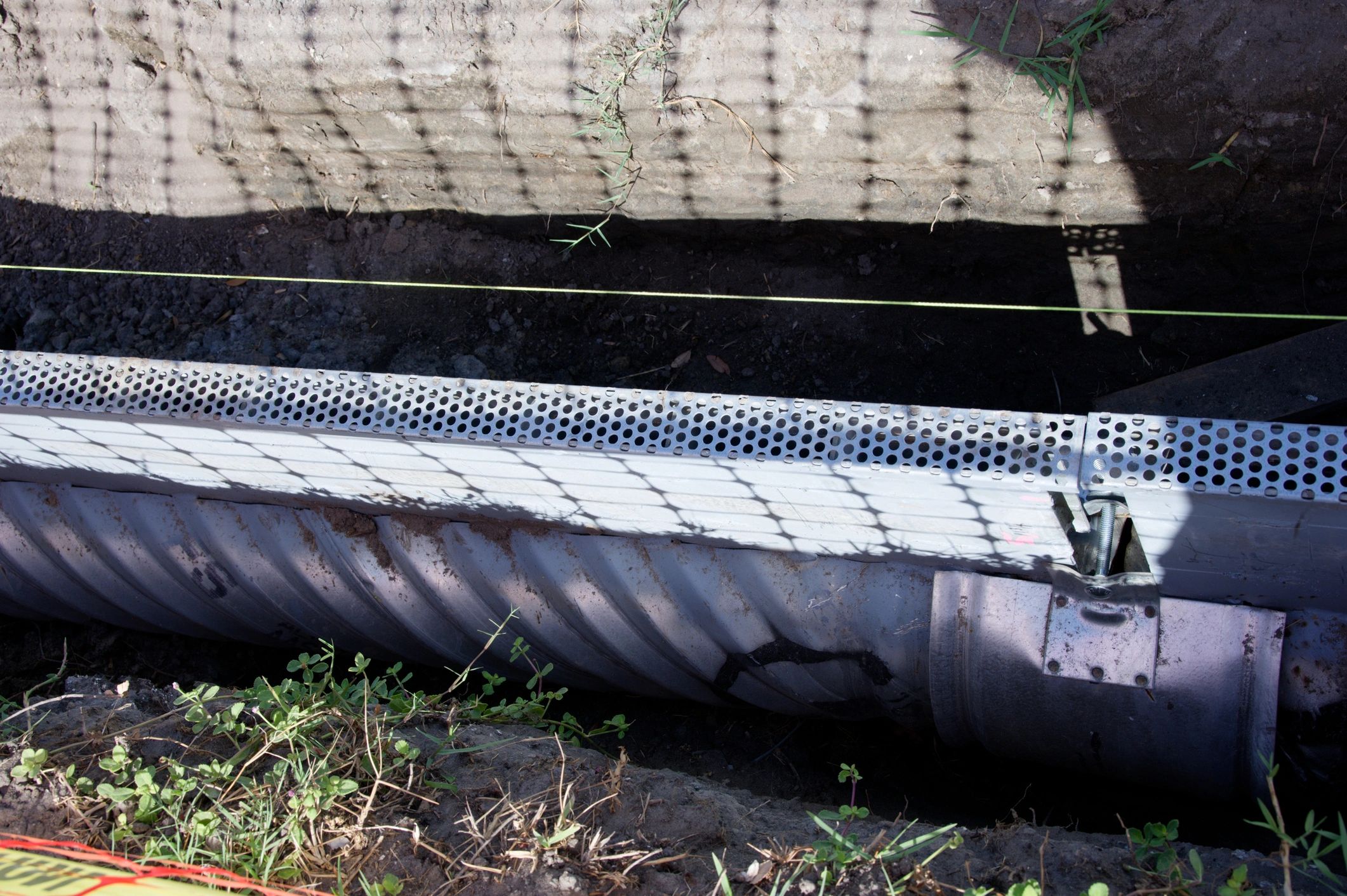
A French drain — sometimes called a rubble drain or trench drain — is a gravel-filled trench containing a perforated pipe. The pipe sits at the base of the trench, wrapped in a geotextile membrane to prevent silt from blocking it. Groundwater seeps through the gravel, enters the pipe through its perforations, and is carried away to a soakaway, drainage ditch, or surface water drain.
The name comes from Henry Flagg French, an American agriculturalist who popularised the technique in the 1800s — though the principle of using gravel-filled trenches to manage water is far older than that.
Modern French drains use high-quality perforated HDPE pipe and purpose-made filter fabric, making them far more durable and effective than older rubble-filled versions.
How French Drains Prevent Damp
Damp in homes rarely appears out of nowhere. In most cases, it's the result of water finding a path of least resistance — and that path often leads straight through your walls or floor.
Rising Damp
When the ground around your property becomes saturated, water can wick upwards through masonry and concrete via capillary action. This is rising damp, and it's responsible for the tide marks, peeling plaster, and musty smell that many Bristol homeowners are all too familiar with.
A French drain installed along the perimeter of a property intercepts groundwater before it reaches the wall. By lowering the water table in the immediate vicinity of your foundations, it removes the source of the problem rather than just treating the symptom.
Penetrating Damp
Heavy rainfall can also drive water horizontally through walls, particularly in older properties with solid masonry construction. If water is pooling against an external wall — perhaps in a sunken garden, a basement light well, or against a retaining wall — it will eventually find its way through.
A French drain positioned at the base of the affected wall captures this surface and near-surface water and diverts it away before it can penetrate the structure.
Basement and Cellar Flooding
For properties with basements or cellars, a French drain installed at foundation level (sometimes called a curtain drain) can be transformative. Combined with an internal drainage channel and sump pump, it forms a complete water management system that keeps below-ground spaces dry year-round.
French Drains and Subsidence: What's the Connection?
Subsidence — the downward movement of the ground beneath a building — is one of the most serious and costly problems a homeowner can face. In the Bristol area, it's a genuine concern, particularly on properties built on shrink-swell clay soils.
How Water Causes Subsidence
Clay soils expand when wet and contract when dry. During prolonged dry spells, clay shrinks and the ground beneath your foundations can drop, causing the building above to move. During wet periods, the same clay swells, creating upward pressure.
This cycle of expansion and contraction is the primary driver of subsidence in clay-rich areas like much of Bristol and the surrounding South West.
Excess groundwater makes the problem worse in two ways:
1. **Soil saturation** — Waterlogged soil loses its load-bearing capacity. Foundations that were designed for stable, well-drained ground can begin to shift when the soil beneath them becomes consistently saturated.
2. **Erosion** — Water moving through or beneath the soil can wash fine particles away over time, creating voids beneath foundations. This is particularly common near older drainage systems, leaking pipes, or in areas with high groundwater flow.
How a French Drain Helps
By intercepting and redirecting groundwater before it reaches your foundations, a French drain helps maintain consistent soil moisture levels. This reduces the severity of the shrink-swell cycle and keeps the ground beneath your property in a more stable condition.
It won't reverse existing subsidence — that requires underpinning — but it can prevent further movement and is often recommended as part of a remediation package alongside structural repairs.
If you've had a subsidence claim or your insurer has flagged drainage as a contributing factor, installing a French drain is frequently one of the first remedial measures recommended by structural engineers.
Where Are French Drains Most Commonly Installed?
French drains are versatile and can be installed in a wide range of locations depending on where the water problem originates:
- **Around the perimeter of a property** — to intercept groundwater before it reaches the foundations - **Along the base of retaining walls** — to relieve hydrostatic pressure that can cause walls to bow or crack - **Across sloping gardens** — to capture surface runoff before it reaches the house - **In driveways and patios** — to prevent pooling and protect the sub-base - **In basement light wells** — to drain water that collects in below-ground areas - **Across agricultural land or large gardens** — to improve drainage and prevent waterlogging
What Does French Drain Installation Involve?
A properly installed French drain is not a DIY job. Getting the depth, gradient, and outlet right is critical — a poorly graded drain will hold water rather than move it, making the problem worse.
Here's what a professional installation typically involves:
1. Site Survey and Design
Before any digging begins, the drainage pattern of your site needs to be understood. Where is the water coming from? Where can it safely be discharged? Is there an existing drainage system it can connect to, or will a soakaway be needed?
A thorough survey prevents costly mistakes and ensures the drain is positioned and sized correctly for your specific situation.
2. Excavation
The trench is excavated to the required depth — typically between 300mm and 1,200mm depending on the application. For perimeter drains protecting foundations, the trench usually needs to reach below the foundation level.
3. Membrane and Pipe Installation
A geotextile filter fabric is laid into the trench, followed by a layer of clean angular gravel. The perforated pipe is laid on top of the gravel at the correct gradient (a minimum fall of 1:200 is recommended), then covered with more gravel before the membrane is folded over and secured.
4. Backfill and Reinstatement
The trench is backfilled and the surface reinstated — whether that's topsoil and turf, paving, or tarmac. A well-installed French drain should be virtually invisible once complete.
5. Outlet Connection
The pipe is connected to its outlet — a soakaway, an existing surface water drain, or a watercourse (subject to Environment Agency consent). Getting the outlet right is just as important as the drain itself; water needs somewhere to go.
Signs You Might Need a French Drain
Not sure whether a French drain is the right solution for your property? Here are some of the most common indicators:
- Damp patches on ground-floor or basement walls, particularly after heavy rain - Efflorescence (white salt deposits) on external brickwork - A garden that stays wet long after rainfall has stopped - Pooling water on driveways, patios, or paths - Cracks appearing in walls, particularly diagonal cracks from corners of windows and doors - Doors and windows that stick or bind, especially in wet weather - A musty smell in ground-floor rooms or cellars
If you're experiencing any of these, it's worth having a drainage survey carried out to establish whether groundwater is a contributing factor.
French Drains in Bristol: Local Considerations
Bristol's geology presents some specific challenges. Much of the city sits on Mercia Mudstone and Lias Clay — both of which are prone to the shrink-swell behaviour described above. The city's hilly topography also means that surface water runoff can be significant, particularly during the heavy rainfall events that are becoming more frequent with changing weather patterns.
The South West's high annual rainfall — Bristol receives around 850mm per year — means that drainage systems need to be designed with capacity to spare. An undersized French drain that works well in a dry year may be overwhelmed in a wet one.
Our team has extensive experience working in Bristol and across the South West, and we understand the local ground conditions, drainage patterns, and planning requirements that affect drainage work in this area.
Conclusion
A French drain is a straightforward but highly effective solution to one of the most common problems affecting homes in Bristol and the South West. By intercepting groundwater before it reaches your walls and foundations, it tackles damp at source and helps maintain the stable soil conditions that your foundations depend on.
Whether you're dealing with a persistently damp wall, a waterlogged garden, or concerns about subsidence, a properly designed and installed French drain could make a significant difference. Get in touch with our team for a site assessment and honest advice on whether it's the right solution for your property.